NMN vs NR: two NAD+ precursors, no verdict
One is closer to NAD+ in the pathway. The other has a broader human record. Neither fact awards the health-benefit contest.
NMN or NR? The pathway cannot choose.
NMN vs NR sounds like a competition with a winner waiting to be announced. The biochemical distinction is real: NR becomes NMN before becoming NAD+, whereas NMN is one main step from NAD+. Nicotinamide riboside and nicotinamide mononucleotide are different precursors to the same coenzyme, not interchangeable names for NAD+.
Biochemical proximity has not persuaded me of a clinical winner. One fewer biochemical conversion describes the pathway; superiority would need a measured clinical benefit. Both precursors have raised blood NAD+ in human trials without consistently producing clinical benefits. Neither is an FDA-approved drug.
The useful comparison is less tidy: NR's blood dose-response and cardiovascular investigations beside NMN's muscle-insulin-sensitivity and walking findings. Those observations do not come from one matched contest.
Nicotinamide riboside: the remarkably tidy blood result
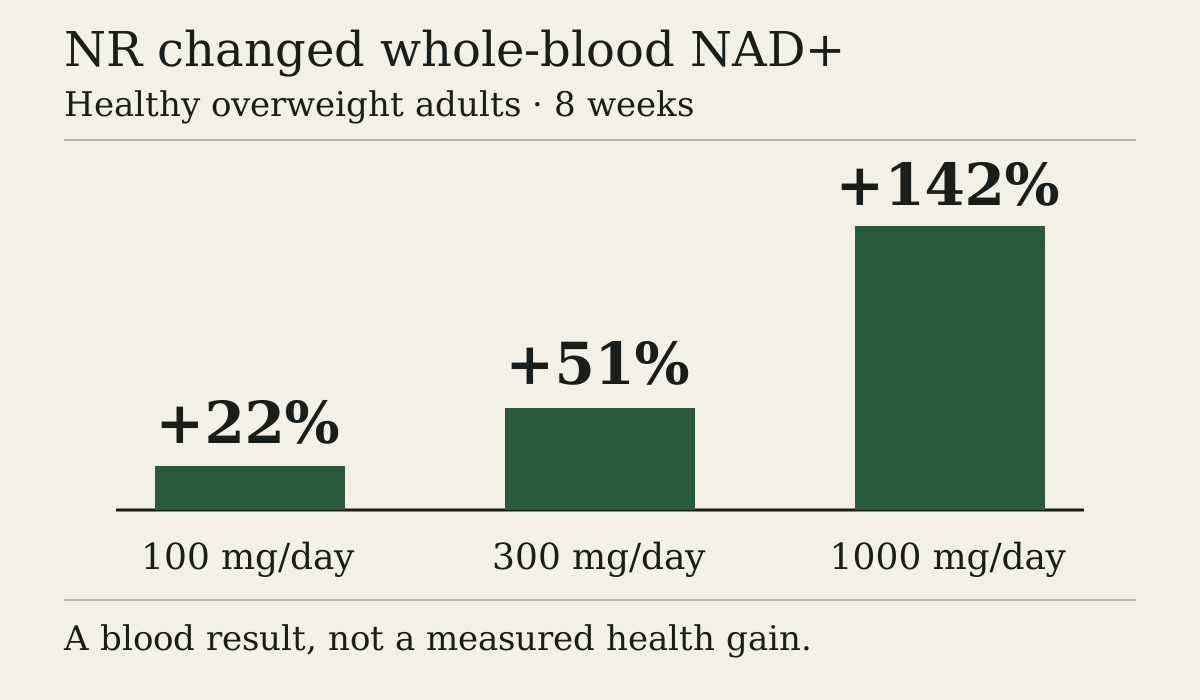
In Conze and colleagues’ randomized NR trial, healthy overweight adults received 100, 300 or 1000 mg/day for eight weeks. Whole-blood NAD+ rose 22%, 51% and 142%, respectively. LDL cholesterol did not rise; there was no reported flushing, and adverse-event rates did not differ significantly from placebo.
NR also appears in the heart-failure safety study and the systolic-pressure and arterial-stiffness work. That wider controlled human record gives NR more endpoints to inspect. A long-term clinical advantage over NMN remains unproved.
I can give this blood result its due without calling it rejuvenation. The study demonstrates a response in the sampled blood. Disease prevention and longevity did not acquire a percentage alongside it.
Nicotinamide mononucleotide: farther walking after 60 days
The multicenter NMN trial in middle-aged adults compared 300, 600 and 900 mg/day for 60 days. Blood NAD+ was higher than placebo on days 30 and 60. Walking distance and quality-of-life scores improved; the blood-based biological-age measure did not increase. The authors identified 600 mg/day as optimal for raising blood NAD+, not as a personal health recommendation. No safety issue was found at the tested amounts.
The separate NMN study in prediabetic, postmenopausal women gave 250 mg/day for ten weeks and found improved muscle insulin sensitivity without a change in body composition or HbA1c. It answers a narrower metabolic question than the walking trial.
NMN's functional findings interest me; ‘one step closer’ tells me much less. They still need a longer human story. A walking-test gain does not establish a longer life, and the trials do not make NR's different endpoints a fair head-to-head comparison.

The supplement dispute is about a legal category
The current source record describes FDA's position that NMN may be excluded from the dietary-supplement definition because it was investigated as a drug. That unsettled marketplace dispute concerns the sales label. It establishes neither a ban nor FDA drug approval, and it supplies no clinical finding that NMN is unsafe.
Legal status cannot settle NMN or NR's efficacy. A familiar supplement category would not make the walking result stronger; a contested category does not erase the blood result.
NMN vs NR: has either pill been proved better?
Read as two channels feeding one coenzyme, the comparison is straightforward. Both raise whole-blood NAD+ dose-dependently in randomized human trials [4][3]. NR has the broader controlled human dataset, including the cleanest dose-response (22/51/142% at 100/300/1000 mg/day) and the most cardiovascular and inflammatory endpoints — the HFrEF safety study and the blood-pressure trial both used NR [4][6][10]. NMN sits one step closer to NAD+ in the pathway and has strong metabolic and multicenter data, including the muscle-insulin-sensitivity result and a 600-mg/day-optimal dose-finding, but it faces the unsettled FDA challenge to its supplement status [1][3].
A fair reading is that the two are more alike than the marketing suggests. Both are oral, both are well tolerated in trials, both reliably lift blood NAD+, and both lack proof of hard clinical benefit. NR's edge is the depth and breadth of its controlled human record; NMN's edge is its proximity to NAD+ in the pathway and its metabolic data — offset by its contested regulatory standing. The 2025 Nature Metabolism review applies to both: blood NAD+ elevation is consistent, but human efficacy for age-related and disease endpoints remains preliminary [15]. The choice the marketplace frames as "NMN vs NR" is, in the published evidence, a choice between two well-tolerated blood-NAD+ raisers whose downstream payoff in people is still being established.
That same evidence discipline applies to NAD+ access: Promise Peptides’ prescription-only care at mypromise.com now includes NAD+, with each case examined by its licensed U.S. clinician and some requests refused. Its patients must be in the United States, and the patient’s state and the particular treatment govern what it can offer. Compounded NAD+ has no FDA approval. The existence of this route does not strengthen the precursor evidence itself.
Swallowed NAD+ faces an absorption barrier
In the NAD+ vs NMN question, the distinction starts before an outcome is measured. Intact NAD+ is poorly taken up whole by most cells; NMN and NR supply material that can be used to build it. Oral precursor results do not establish the effectiveness of swallowing NAD+ itself.
The home examination introduces that difference. The study amounts keep the interventions separate when numbers make them look deceptively comparable.